
The "rebels" of Cape Verde
In the early 1940s, the Catholic Church introduced some changes to the liturgy. There were also some modifications in the way religion was taught until that moment. Catholicism is one of the most hierarchical religions in the world and the changes were introduced without too many problems among the priests and the faithful Catholic community. However, this was not the case in the Portuguese colony of Cape Verde, particularly on the island of Santiago, the largest and most populated of the archipelago.

In these Atlantic islands 900 km off the coast of Senegal, the practice of Catholicism had taken a turn that did not comply with the new demands of the Church. Among other things, some of the Cape Verdean priests were sexually very active, and they did not even try to hide it. They went as far as forming multiple families in the different islands of the colony as they were on evangelical missions.
To put an end to this and some other uncomfortable practices for the Catholic hierarchy, Portugal sent several priests in 1941 to replace the native religious leaders of these communities. On the island of Santiago, a minority rebelled against the imposition of the metropolis and they ended up fleeing to the mountains and other remote places with difficult access. There, they managed to continue with their traditions and practices, but at the same time, they created one of the most isolated communities in the planet as they decided to remain apart from the Church and the State (which at that time in Portugal were very close).
Members of this community were persecuted, detained and ridiculed for daring to challenge the dominant power at the time. As a consequence, they suffered many difficulties that made them complete outcasts. This attitude, further complicated their already harsh living conditions, but despite everything, they remained faithful to their traditions and their religious leaders.
Their protest was based on total disobedience, but always in a peaceful manner. They never committed any act of violence. Instead, they refused to have any type of contact, direct or indirect, with the State or the Church.
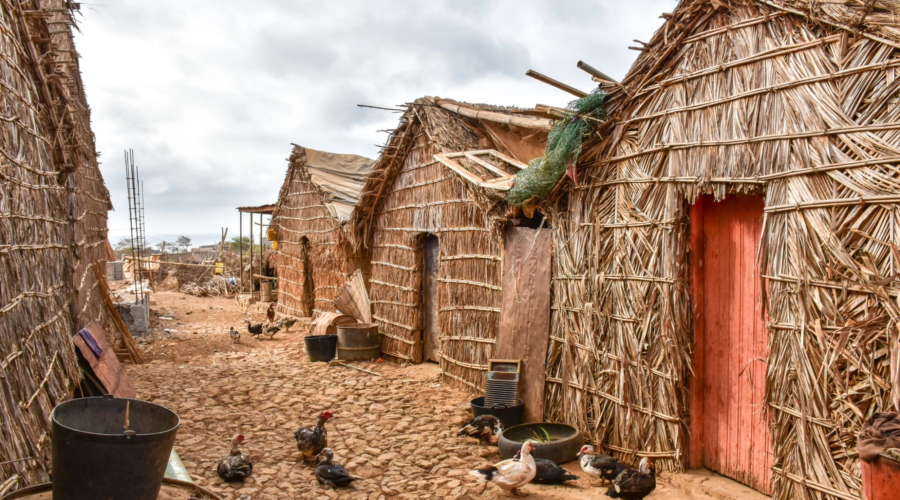
Their children were not attending school and in consequence they lacked any type of formal education. Several generations grew up not knowing how to read or write and none of them was recorded in the civil registry. For practical purposes, they were not citizens like the rest of the Cape Verdean population because they were not identified as such. In fact, it was as if they did not exist at all. In an act of extreme rebellion, they even refused to use proper names. Children were born in the villages but they were not assigned a first name, in fact all of them shared the name Rebels of Our Lord Jesus Christ.
In another step of complete opposition to a society that rejected and marginalised them, they decided not to use any public service, including hospitals. This was a risky move, but they refused vaccination for themselves or their animals.
This community was known as ‘rabelados’ (rebels) and on Saturdays and Sundays they travelled long distances on foot to be able to attend religious ceremonies organised by members of their society. On these days they also observed a full fast until past three in the afternoon.
With the passing of the time and the mediation of a social worker, the situation improved little by little. After the independence of the colony from Portugal in 1975, they began to gradually approach the society they had completely rejected in the past. However, it was a very slow transition since well into the 21st century, many of the rabelados still slept on the floor simply because they were lacking beds. They lived in houses made of cane and although they were a completely self-sufficient society, the living conditions were very harsh indeed.
Today, all children go to school and some of the few remaining rabelados sell paintings for tourists or have a morning job in the city so they can return to their communities in the afternoon. The old wounds have been finally closing and the population is blending with the world they once abandoned. Among the rabelados still remains a feeling of pride for belonging to a group that resisted, and peacefully fought against, the imposition of a political and religious power. Not only did they fight, they also managed to survive. That was a victory in itself.
The case of the rabelados of the island of Santiago is paradigmatic because they opposed the politics of the State and of the Catholic Church. Besides, they refused to be “biologically dictated” as they refused to go to hospitals, taking medicines or being vaccinated. Antonio Carlo Moniz of the University of Cape Verde describes the situation of the rabelados as follows:
“…this population group, living in areas of difficult access, excluded themselves from innovations, from school, from its teachings, from modern medicine and its practices, impregnated with strong religiosity (…). When necessary, they resorted to the traditional pharmacopoeia and quackery practices”.


Comentarios